Declaring Desire, Entering the Wild, Returning Awake: A Psalm-Shaped Retreat
Laura Longville
I appreciate new beginnings, and 2026 is off to a good start! Last fall, I committed to an 8-day retreat to get away with God and a community of like-minded souls. I recently returned from the retreat rested, rejuvenated, and restored.
I am thankful for this opportunity and want to share a bit of my experience with you. My personal experience is bolded. below. A blog I recently read inspired this post.*
“O God, you are my God; eagerly I seek you…” (Psalm 63:1). With this cry, the psalmist pulls us straight to the center of spiritual retreat: hunger. Not duty. Not productivity. Desire. A true retreat begins when we dare to name what our souls ache for and place that longing honestly before God. As another psalm gives voice to this ache, “As the deer longs for streams of water, so I long for you, my God” (Psalm 42:1). Retreat begins not with answers, but with thirst.
Over the past few years, my longing and thirst for God have risen and receded like the tide. I sensed an invitation to lean further into His presence by withdrawing into quiet, solitude, and holy community. Though I came with a handful of intentions, my deepest desire was simple: to make room, to listen, and to encounter God.
The Psalms refuse vague spirituality. They teach us to declare intention out loud—to say, with trembling clarity, “Here’s the one thing I crave from YAHWEH…” (Psalm 27:4). Declaring intention is not about having our hearts perfectly sorted; it is about opening them fully. It clears the clutter, silences competing loyalties, and gathers our scattered selves into a single, holy yearning. And yet, intention does not give us control. More often than not, what we intend to seek gives way to what God longs to reveal. The Spirit is not searching for flawless focus, but for humility, courage, and truth.
I made the commitment.
I said yes with my body and my calendar—
fees paid, flights booked, car reserved,
the ordinary rhythms of life gently set aside.
For three months, I held the question in prayer:
What is it I am truly seeking in this time away?
Slowly, my hopes came into focus,
not as demands, but as invitations.
I longed to encounter God more attentively
through the quiet discipline of Centering Prayer—
to rest in God’s presence beyond words.
I desired to sense God’s holiness,
to stand again on holy ground with open hands.
I carried a word for the year—Unfolding—
and I wanted to glimpse what God might be revealing,
how this word might take shape in my life.
Even my sleep, those hidden hours of rest,
I offered to God, trusting they too could be healed and reordered.

Yet intention did not grant control.
Almost immediately, my expectations collided with reality.
The schedule I imagined gave way to something altogether different.
I was invited—not gently at first—to surrender,
to release my grip and trust both the process and God.
It was not easy.
The days stretched me, unsettled me, and slowly reshaped me.
In time, a rhythm emerged—
one that both nurtured and challenged my soul,
and taught me how to listen more deeply
to the God who was already at work.
Once intention is named, retreat carries us—almost inevitably—into wilderness. This can be jarring. We expect peace and instead encounter restlessness. We anticipate clarity and meet silence. The Psalms are unflinchingly honest about this terrain. Wilderness is not an interruption of retreat; it is its crucible. Here distractions surface, temptations whisper, and discouragement presses close. Yet this barren place is also holy ground. It is the threshold where illusions fall away and God meets us without props or performance.
For me, the wilderness of this retreat took the form of silence—
not silence from God, but a sacred quiet.
Though there were thirty-seven of us gathered,
we did not speak to one another for five days.
Instead, we shared our lives without words:
three meals a day at the same tables,
prayers lifted side by side,
bodies stretched and awakened together,
and long hours of silent prayer held in common.
Outwardly, distractions were few.
Inwardly, they were many—
the steady hum of my own thoughts,
the rising and falling of feelings,
ideas clamoring for attention,
some restless and insistent,
others surprisingly good and life-giving.
Yet it was here, in this uncluttered quiet,
that I came to recognize holiness.
The silence did not empty the space;
it revealed it.
This wilderness of quiet became holy ground—
a place where God was already present,
waiting to be noticed.
In the wilderness, we learn to wait. Waiting stretches us, strips us, and steadies us. The Psalms teach us how to stand watch—eyes open, hearts anchored, hope intact—even when dawn feels slow in coming. This kind of waiting does not weaken faith; it deepens it. It trains us to trust that God’s Word never returns empty, even when it arrives quietly.
My waiting in the wilderness of silence stirred agitation, confusion, and uncertainty.
Nothing resolved quickly.
Nothing hurried me toward clarity.
Yet, in time, the unrest softened.
What once unsettled me slowly opened into trust—
a deeper reliance on God who did not rush the process.
From that trust grew intimacy:
with God,
with my own soul,
and with those journeying alongside me.
Though we never spoke a word,
something holy was shared.
In the quiet, we were known—
not through conversation,
but through presence, patience,
and the gentle work of God unfolding within us.
And then, almost imperceptibly, gifts appear. A phrase of Scripture burns brighter. An insight settles gently. A truth lodges itself deep within. These are the “scraps” of retreat—bread from heaven for the road ahead. They are meant to be gathered, cherished, and revisited because they tell a story of God’s faithfulness that unfolds over time.
God made His way deep within me in quiet yet powerful ways.
There were two moments in particular that marked me.
I would love to share both, but the first would require more words than this page can hold.
If you ever wish to hear it, I would be honored—
just call, and I will gladly tell you the story.
What I will share is this image.
This was the view from my bed.
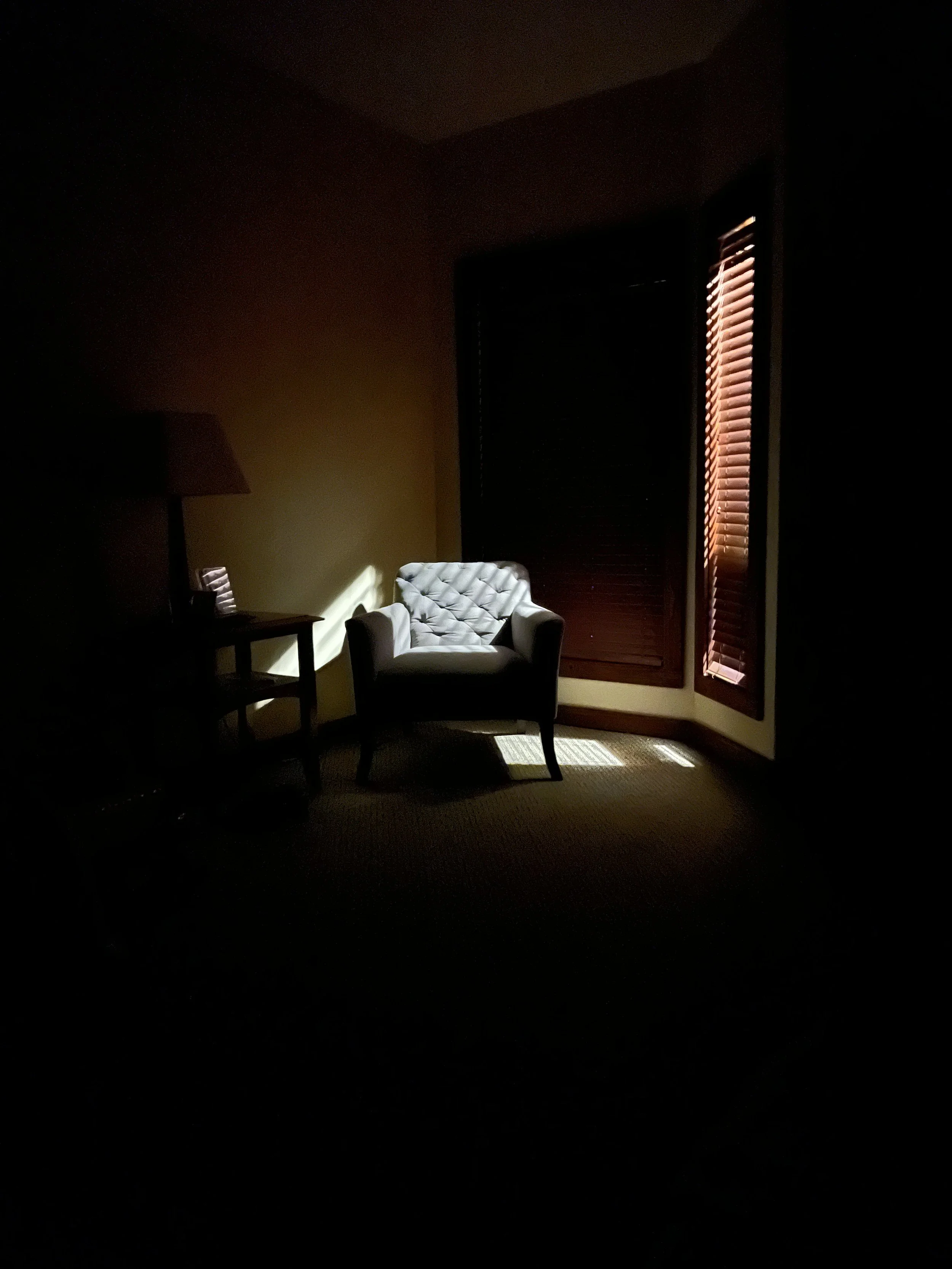
On the first night, as I turned off the light and settled into bed,
my eyes rested there—and something in me knew.
I sensed God’s presence, gentle and attentive,
as though He sat in that chair, watching over me through the night.
I slept deeply—night after night—
all but one, and even then, I woke each morning
with a quiet assurance:
I was cared for.
I was seen.
I was loved by God.
This memory has lodged itself in my heart.
I will carry it with me for the rest of my life.
Finally, retreat sends us back. Not back to “real life,” but back to a waiting world—changed, awakened, and attentive. “Better is one day in your courts than a thousand elsewhere” (Psalm 84:10). The Psalms remind us that pilgrimage continues long after silence ends. We go from strength to strength, carrying within us a deeper thirst, a steadier hope, and a heart more fully alive to God.
This is the gift of a Psalm-shaped retreat: not escape, but immersion; not answers, but presence; not control, but transformation.
“As I return to the rhythms of ordinary days, I do not return the same.”
As I return to the rhythms of ordinary days,
I do not return the same.
Something within me has shifted—
quietly, deeply, from the inside out.
I carry the knowing that God dwells within me,
walking beside me, guiding my steps.
What was renewed in silence now moves with me into motion—
a freedom, a steadiness, a living connection.
And so I continue on as a pilgrim,
held by hope, strengthened for the journey,
and opened wider in love
for all those I meet along the way.
*The Psalm Shaped Retreat was inspired by these two authors, who shared their retreat experience. It’s worth a read. Click here